
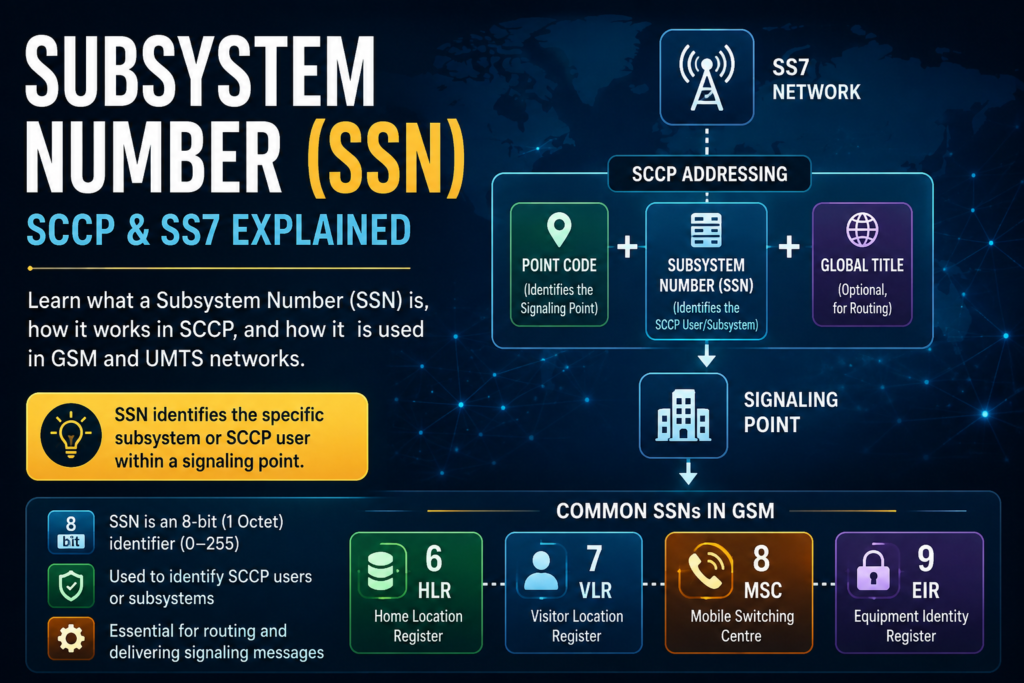
A Subsystem Number (SSN) is an identifier used in Signalling Connection Control Part (SCCP) networks to identify a specific subsystem or SCCP user within a signalling point.
It helps SCCP deliver signalling information to the correct function inside a network node.Subsystem numbers are commonly associated with SS7 signalling and mobile networks such as GSM and UMTS.
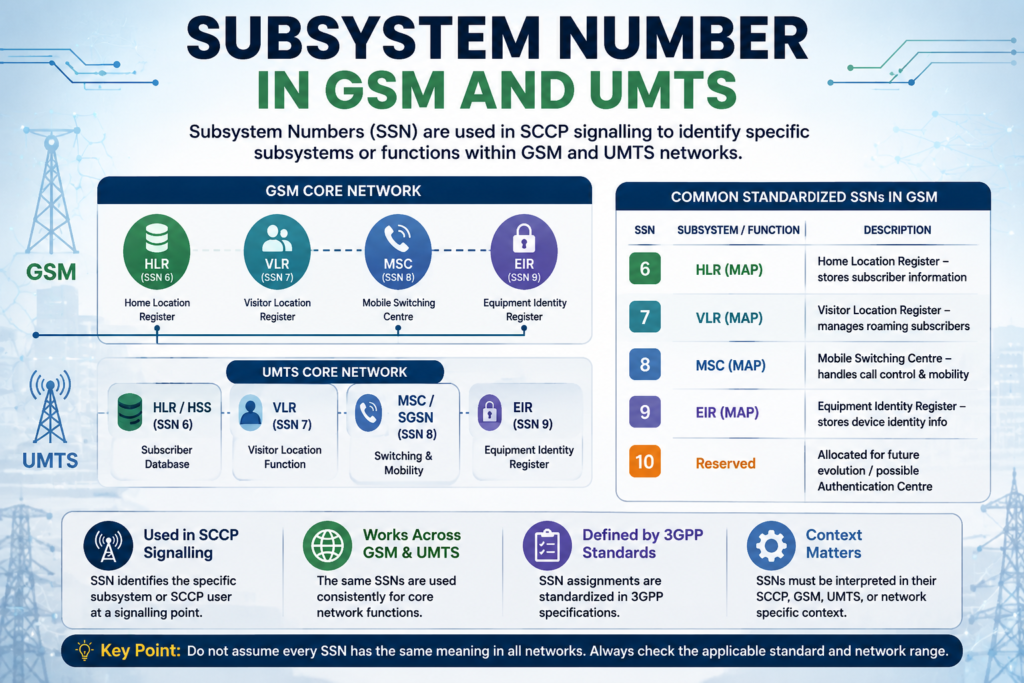
For example, GSM uses standardized subsystem numbers for functions such as the Home Location Register (HLR), Visitor Location Register (VLR), Mobile Switching Centre (MSC), and Equipment Identity Register (EIR).
What Is a Subsystem Number?
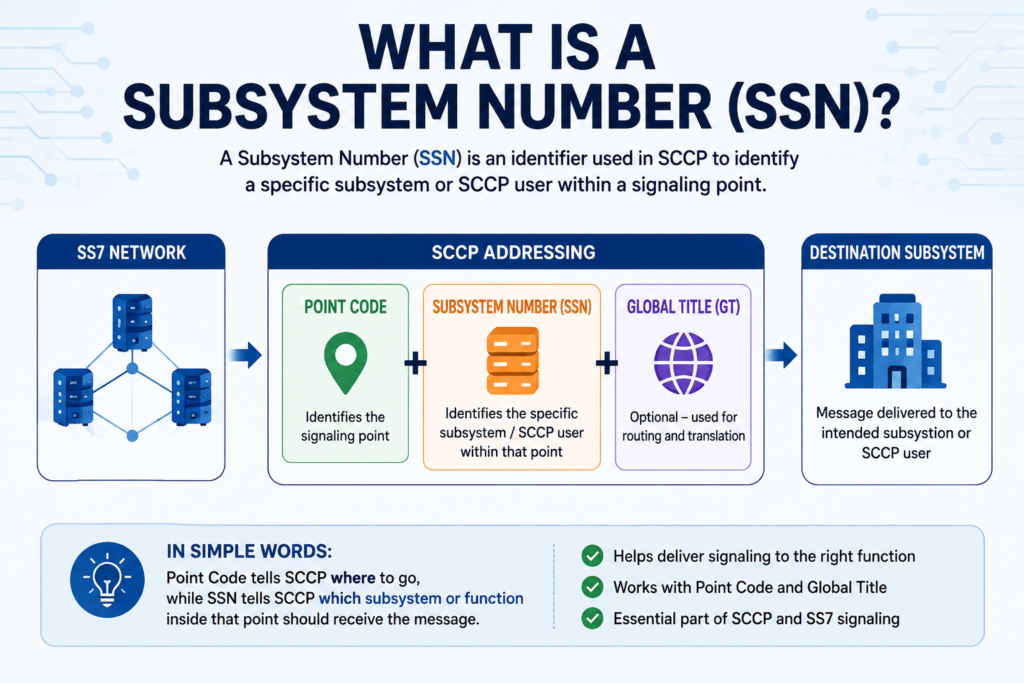
A Subsystem Number, usually written as SSN, identifies an SCCP-accessible user or subsystem at a signalling point.
In simple terms, a network node can contain several signalling functions. The point code helps identify the signalling point, while the SSN identifies the particular SCCP user or subsystem that should handle the message.
This makes SSN an important part of SCCP addressing. ITU-T documentation describes the subsystem number as identifying an SCCP user when it is included in the address.
What Does SSN Stand For?
In telecommunications, SSN stands for Subsystem Number.
The abbreviation can also mean Social Security Number in another context, but that is unrelated to SCCP and SS7. In this article, SSN refers only to Subsystem Number.
How Does a Subsystem Number Work?
SCCP uses addressing information to determine where signalling information should be delivered. Depending on the address and routing method, an SCCP address can include a point code, subsystem number, Global Title, or a combination of these elements.
A simple way to understand the process is:
SS7 network → SCCP → Signalling Point → Subsystem
The point code identifies the relevant signalling point, while the SSN can identify the SCCP user or subsystem at that point.
For example, if several SCCP-based functions are available at one signalling point, their subsystem numbers can help distinguish the intended destination.
What Is SCCP?
SCCP stands for Signalling Connection Control Part. It is a component of the SS7 signalling architecture that provides additional addressing and signalling capabilities above the basic Message Transfer Part (MTP).
SSN is part of the SCCP addressing system. The SCCP address can indicate whether routing should be performed using a subsystem number or a Global Title.
ITU-T Q.713 defines the address indicator and the information used for these addressing options.This is why understanding SCCP makes the purpose of a subsystem number much easier to understand.
How Many Bits Does a Subsystem Number Have?
An SSN is carried in an 8-bit field, or one octet, in SCCP addressing.An 8-bit field can represent values from 0 to 255. However, that does not mean every value is freely available for any application.
Standardized, reserved, national, and network-specific assignments determine how individual values are used.
For GSM, for example, standardized SSN assignments occupy specific values rather than using the entire range without restrictions.
Common Subsystem Numbers in GSM
GSM defines standardized subsystem numbers for several important network functions.
SSN 6 — HLR
SSN 6 is assigned to the Home Location Register (HLR) in the standardized GSM subsystem number assignments.
The HLR is a core network database associated with subscriber information and services. In SCCP signalling, the SSN helps identify the HLR function when that function is the intended destination.
SSN 7 — VLR
SSN 7 is assigned to the Visitor Location Register (VLR).
The VLR supports subscriber and mobility-related functions in the serving mobile network. Its standardized SSN allows the VLR function to be identified within SCCP-based signalling.
SSN 8 — MSC
SSN 8 is assigned to the Mobile Switching Centre (MSC).
The MSC is an important component of traditional GSM core networks and handles switching and mobility-related functions.
SSN 9 — EIR
SSN 9 identifies the Equipment Identity Register (EIR) in the standardized GSM assignments.
The EIR is associated with mobile equipment identity information and related network functions.
Subsystem Number Ranges in GSM
GSM does not simply use one continuous range of SSNs for every purpose.According to the GSM subsystem numbering rules, SSNs used between Public Land Mobile Networks (PLMNs) can come from the globally standardized range 1–31 or from the GSM-reserved portion 129–150 of the national range.
For use within a PLMN, other parts of the national range are available, including 32–128 and 151–254, subject to the applicable assignments and reservations.
This distinction is important because saying that “all GSM SSNs are between 1 and 31” would be incorrect.
Subsystem Number vs Point Code
A subsystem number and a point code are related, but they do different jobs.
| Identifier | What it identifies |
| Point Code | A signalling point or network node |
| Subsystem Number (SSN) | An SCCP user or subsystem at that signalling point |
| Global Title (GT) | Address information that can be used in SCCP routing and translation |
A simple analogy is a large office building.
The point code is similar to the building’s address, while the SSN is similar to identifying a particular department inside that building.
This is not a literal representation of how SS7 works, but it is a useful way to understand the difference between the two identifiers.
Subsystem Number and Global Title
SCCP can use Global Title (GT) information as part of its addressing and routing process.
The routing indicator in an SCCP address can specify whether routing should be performed using the subsystem number or the Global Title. When Global Title routing is used, Global Title Translation can be performed to determine the information needed for further routing.
This means SSN and Global Title are not competing names for the same thing. They are different parts of the SCCP addressing and routing system.If you want to learn more about network addressing, see our guide to IP addresses.
Why Are Subsystem Numbers Important?
Subsystem numbers provide a way to distinguish SCCP users or subsystems at a signalling point.
They are useful because a single network node may support more than one signalling function. Instead of treating the entire node as one destination, SCCP can use the subsystem number to identify the particular function involved.
In GSM and related mobile networks, standardized SSNs make it easier to identify common network functions such as HLR, VLR, MSC, and EIR.
SCCP Subsystem Management
SCCP also includes procedures for managing the status of subsystems.
For example, SCCP management can communicate information about whether a subsystem is allowed, prohibited, or needs its status checked. This allows network equipment to respond when a subsystem becomes unavailable or changes state.
SCCP management messages include functions such as Subsystem Allowed (SSA), Subsystem Prohibited (SSP), and Subsystem Status Test (SST). These procedures use subsystem-related addressing information to identify the affected function.
This management capability is one reason SSN is more than a simple label. It participates in the operational handling of SCCP-based signalling.
Subsystem Number in GSM and UMTS
Subsystem numbers are particularly relevant in mobile networks that use SCCP signalling.In GSM, standardized SSNs identify several core network functions. The broader 3GPP specifications also define subsystem numbers for functions used with GSM and UMTS network entities and interfaces.
The exact SSN assignment depends on the function and the applicable standard or network range. Therefore, an SSN should always be interpreted in its SCCP, GSM, UMTS, or network specific context rather than assuming that every SSN has the same meaning everywhere.For more practical guides on technology, digital tools, and other useful topics, explore Pepper0.
Conclusion
A Subsystem Number (SSN) is an important part of SCCP addressing in SS7-based signalling networks. It identifies an SCCP user or subsystem and helps distinguish the intended signalling function within a network node.
GSM provides clear examples of SSN use, including HLR (6), VLR (7), MSC (8), and EIR (9). Understanding SSN alongside SCCP, point codes, and Global Title routing provides a clearer picture of how signalling destinations are identified in traditional mobile networks.
Frequently Asked Questions
What is a subsystem number?
A subsystem number (SSN) is an SCCP identifier used to identify an SCCP user or subsystem at a signalling point.
What does SSN stand for?
In the SCCP and SS7 context, SSN stands for Subsystem Number.
What is SSN in SCCP?
SSN is the subsystem number used by SCCP to identify the intended SCCP user or subsystem within a signalling point.
How many bits is an SSN?
An SSN is carried in an 8-bit field, which is one octet.
What is SSN 6?
In the standardized GSM assignments, SSN 6 identifies the HLR (Home Location Register).
What is SSN 7?
SSN 7 identifies the VLR (Visitor Location Register) in the standardized GSM assignments.
What is SSN 8?
SSN 8 identifies the MSC (Mobile Switching Centre) in the standardized GSM assignments.
What is SSN 9?
SSN 9 identifies the EIR (Equipment Identity Register) in the standardized GSM assignments.
Is SSN the same as a point code?
No. A point code identifies a signalling point, while an SSN identifies an SCCP user or subsystem associated with that signalling point.