
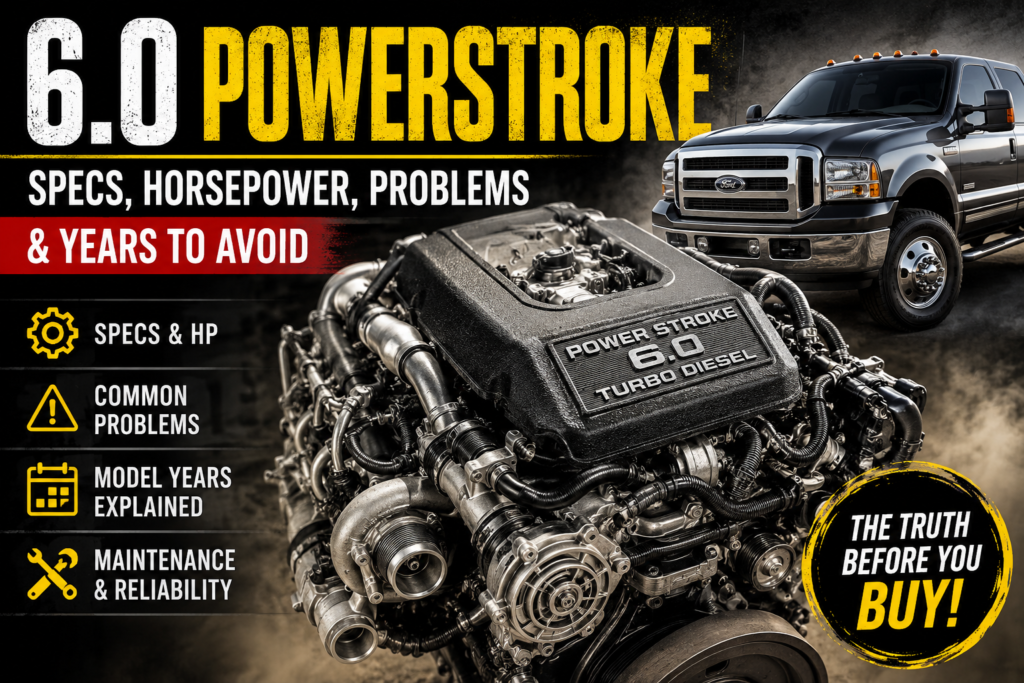
The 6.0 Powerstroke is a 6.0-liter turbocharged diesel V8 used in Ford Super Duty trucks from 2003 through 2007. It replaced the 7.3 Powerstroke and became known for strong torque and towing performance.
It also has a reputation for reliability problems, including EGR, oil cooler, FICM, injector, turbocharger and head gasket issues. That does not mean every 6.0 Powerstroke is unreliable, but maintenance and repair history matter a lot.
This guide covers the 6.0 Powerstroke specs, horsepower, common problems, model years, maintenance and reliability so you can better understand the engine before buying or maintaining one.
What Is the 6.0 Powerstroke?
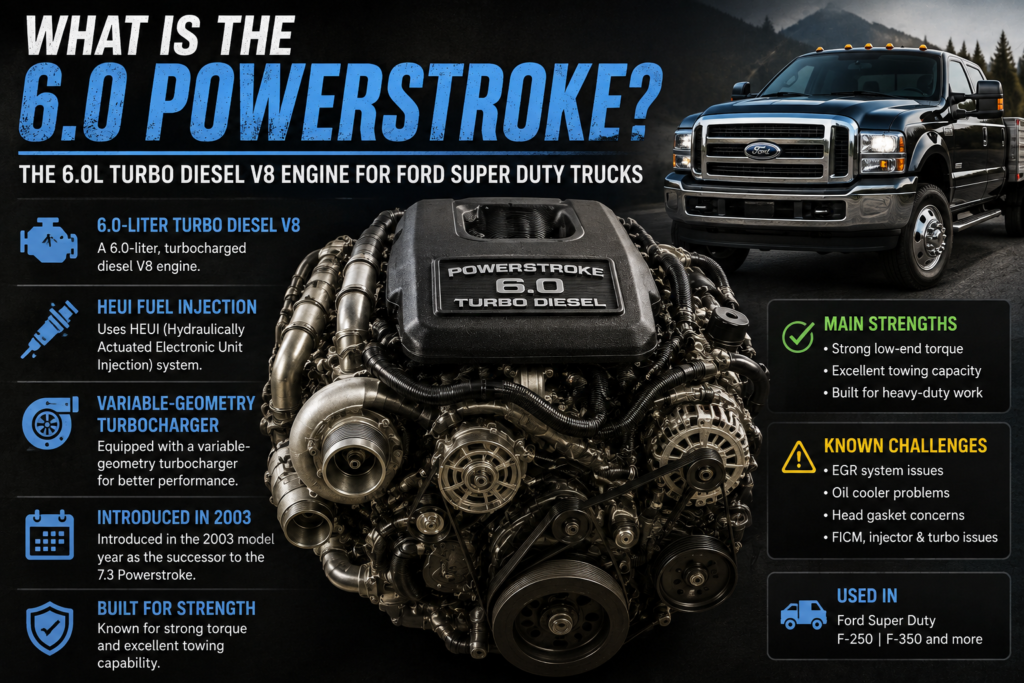
The 6.0 Powerstroke is a 6.0-liter turbocharged diesel V8 developed for Ford Super Duty trucks. It uses a HEUI fuel injection system and a variable-geometry turbocharger.
Ford introduced it during the 2003 model year as the successor to the 7.3 Powerstroke. The engine was used in Super Duty models such as the F-250 and F-350.
Its main strengths are strong torque and good towing capability. However, the engine has several known problem areas that owners need to understand.
6.0 Powerstroke Specs
The 6.0 Powerstroke has a 6.0-liter displacement, V8 configuration, turbocharger, and HEUI fuel injection system. Ford paired it with manual and automatic transmissions depending on the truck configuration.
For 2003–2004 Super Duty models, Ford rated the engine at 325 horsepower and 560 lb-ft of torque. From 2005–2007, horsepower stayed at 325 hp while torque increased to 570 lb-ft.
| Specification | 6.0 Powerstroke |
| Displacement | 6.0 liters |
| Configuration | V8 diesel |
| Turbocharger | Variable geometry |
| 2003–2004 HP | 325 hp |
| 2003–2004 Torque | 560 lb-ft |
| 2005–2007 HP | 325 hp |
| 2005–2007 Torque | 570 lb-ft |
How Much Horsepower Does a 6.0 Powerstroke Have?
A stock 6.0 Powerstroke produces 325 horsepower in Ford Super Duty applications. The rating remained the same across the main 2003–2007 production period.
Torque is where the later models gained a small advantage. The 2003–2004 versions produced 560 lb-ft, while 2005–2007 models produced 570 lb-ft.
Modified engines can make much more power with tuning and aftermarket parts. However, extra power can put more stress on the engine and its supporting components.
6.0 Powerstroke Problems and Common Issues
The most common 6.0 Powerstroke problems involve the EGR system, oil cooler, FICM, injectors, turbocharger, high-pressure oil system, and head gaskets.
An EGR cooler or oil cooler problem can lead to cooling issues and, if ignored, more serious engine damage. Head-gasket problems are also a major concern because excessive cylinder pressure can cause sealing problems.
FICM and injector issues can cause hard starting, rough running, stalling, or poor performance. Turbocharger and high-pressure oil problems can also cause loss of power or starting issues.
6.0 Powerstroke Years to Avoid
Searching for 6.0 Powerstroke years to avoid can be misleading because there is no single year that should automatically be rejected. Ford made several running changes throughout production.
The 2003 model was the introduction year and received multiple updates during production. Ford also made important changes during 2004 and later years to components such as the injectors, EGR cooler, high-pressure oil system, and cooling system.
When buying one today, condition matters more than the model year alone. A well-maintained truck with documented repairs can be a better choice than a newer example with poor maintenance.
2003–2006 6.0 Powerstroke: What Changed?
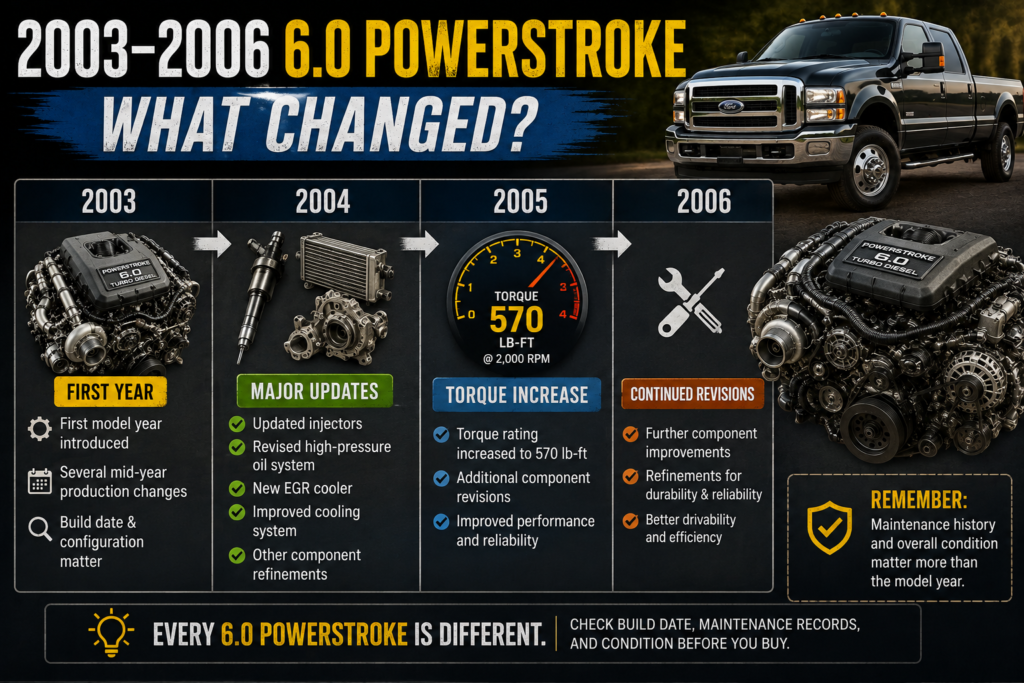
The 2003 6.0 Powerstroke went through several production changes because it was the first model year. This makes the engine’s build date and specific configuration important when evaluating an early truck.
Ford introduced more updates in 2004, including changes to the injectors, high-pressure oil system, EGR cooler, cooling system, and other components. Some 2004 trucks can therefore differ depending on when they were built.
The 2005 and 2006 models received additional revisions, while the factory torque rating increased to 570 lb-ft from 2005 onward. Still, maintenance history is more important than simply choosing a particular year.
6.0 Powerstroke Maintenance and Reliability
Good 6.0 Powerstroke maintenance starts with regular oil and filter changes, proper coolant service, and attention to the fuel and cooling systems. Neglecting basic maintenance can make existing problems much worse.
Watch for symptoms such as coolant loss, overheating, hard starting, rough running, stalling, smoke, or loss of power. These signs do not always point to one specific failure, so proper diagnosis is important.
If you are buying a used truck, ask for maintenance and repair records. A 6.0 Powerstroke with a documented service history is usually easier to evaluate than one with an unknown past.
How Long Can a 6.0 Powerstroke Last?
There is no fixed mileage figure for every 6.0 Powerstroke. Engine life depends on maintenance, driving conditions, repairs, modifications and how heavily the truck has been used.
A truck that regularly tows heavy loads needs more attention than one used for light driving. Aftermarket tuning can also increase performance while putting additional stress on engine components.
Instead of judging a truck by mileage alone, check its maintenance records and mechanical condition. A properly serviced higher-mileage truck can sometimes be a better purchase than a neglected low-mileage example.
Is the 6.0 Powerstroke a Good Engine?
The 6.0 Powerstroke has real strengths. Its 325 horsepower and up to 570 lb-ft of torque give it enough power for towing, hauling, and other heavy-duty work.
Its weakness is the number of known failure points. EGR, oil cooler, FICM, injector, turbocharger, and head-gasket problems can become expensive if they are ignored.
So, is it a good engine? It can be, if it has been properly maintained and repaired. When buying one, focus on the truck’s condition and service history rather than relying only on its reputation.For more automotive and technology guides, visit Pepper0.
6.0 Powerstroke vs. 7.3 Powerstroke
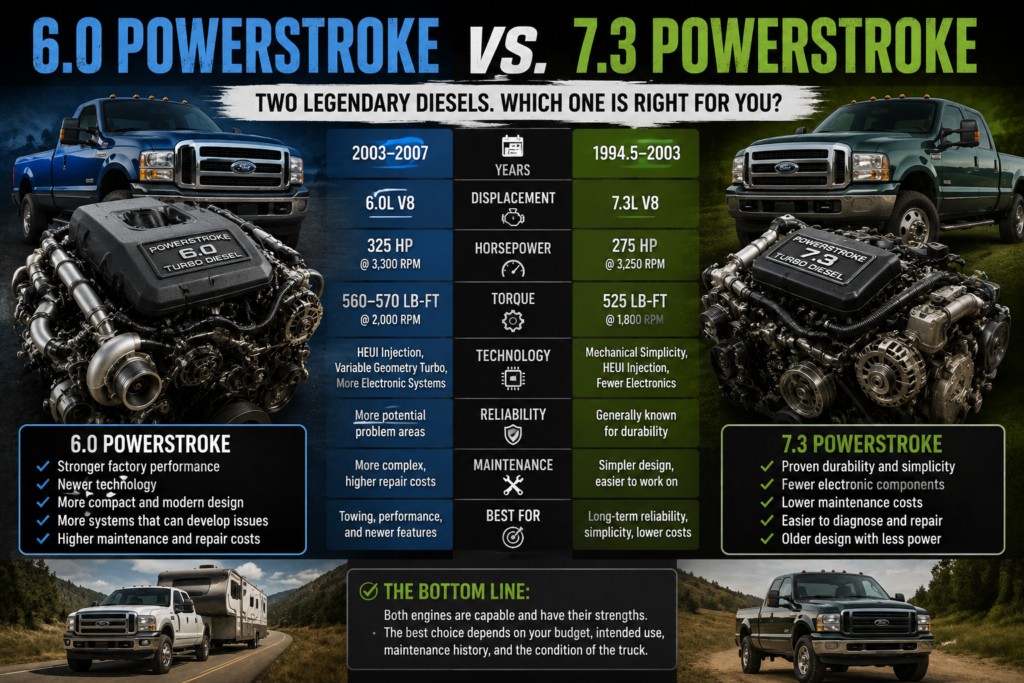
The 6.0 Powerstroke replaced the 7.3 Powerstroke during Ford’s 2003 model-year transition. It brought newer technology, more compact packaging, and strong factory performance.
The 7.3 is generally valued for its simpler design and reputation for durability. The 6.0 offers newer technology and strong performance but has more systems that can develop problems.
For a used truck, the better choice depends on your budget, intended use, maintenance history, and the condition of the individual engine.For more practical guides on other technology and everyday topics, you can also explore this text message recovery guide.
Conclusion
The 6.0 Powerstroke offers strong horsepower and torque, making it capable of towing and heavy-duty work. Its main drawback is the number of known mechanical issues.
If you are considering one, do not choose based on model year or mileage alone. Check the maintenance records, previous repairs, cooling system, fuel system, and overall engine condition.The best 6.0 Powerstroke is the one that has been properly maintained and repaired—not simply the one with the lowest mileage.
FAQ
How much torque does a 6.0 Powerstroke have?
2003–2004 models were rated at 560 lb-ft, while 2005–2007 models were rated at 570 lb-ft.
Is the 6.0 Powerstroke reliable?
It can be reliable when properly maintained, but it has several known problem areas. Good service history and quality repairs make a major difference.
What 6.0 Powerstroke years should I avoid?
There is no single year that every buyer should avoid. Check the specific truck’s build date, maintenance history, previous repairs, and current condition.
What is the horsepower of a 6.0 Powerstroke?
A stock Ford Super Duty 6.0 Powerstroke produces 325 horsepower. Later models increased torque from 560 to 570 lb-ft.
What are the main 6.0 Powerstroke problems?
Common issues include EGR and oil cooler problems, FICM failure, injector issues, turbocharger problems, high-pressure oil leaks, and head-gasket concerns.