
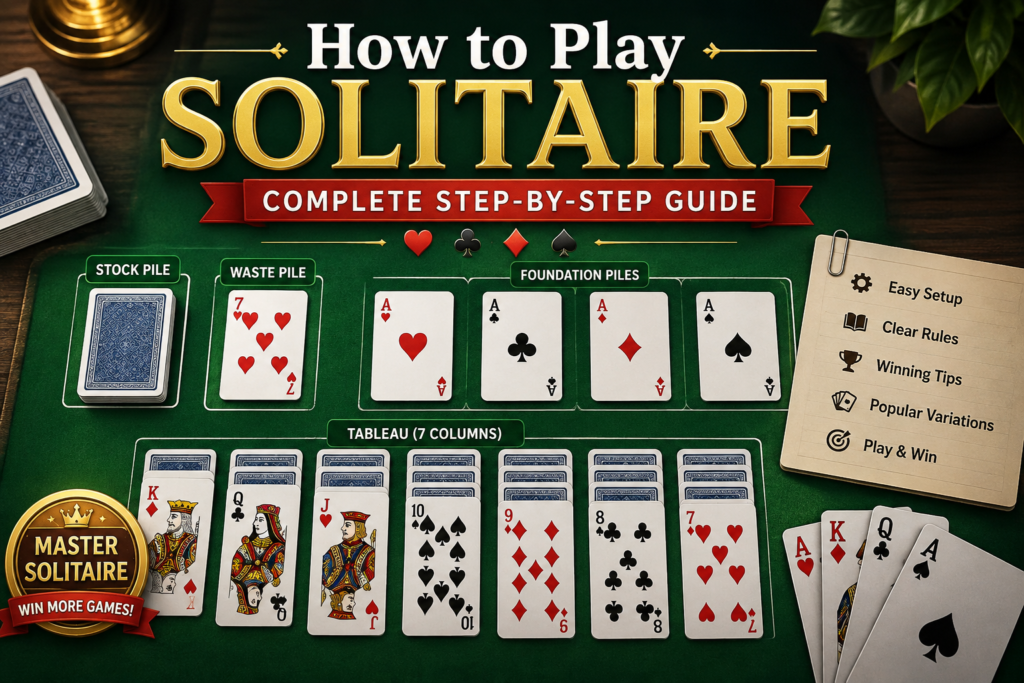
I’ve spent more nights than I’d like to admit shuffling a deck at the kitchen table trying to get four aces up before running out of moves.
Solitaire is one of those games that looks simple until you actually sit down to learn how to play a solitaire card game. Then you realize there are a handful of rules that make or break every round.
This guide walks you through the setup, the rules, the popular variations and the small mistakes that trip up almost every beginner. By the end you’ll be able to deal a hand and play with confidence.
What Is Solitaire?
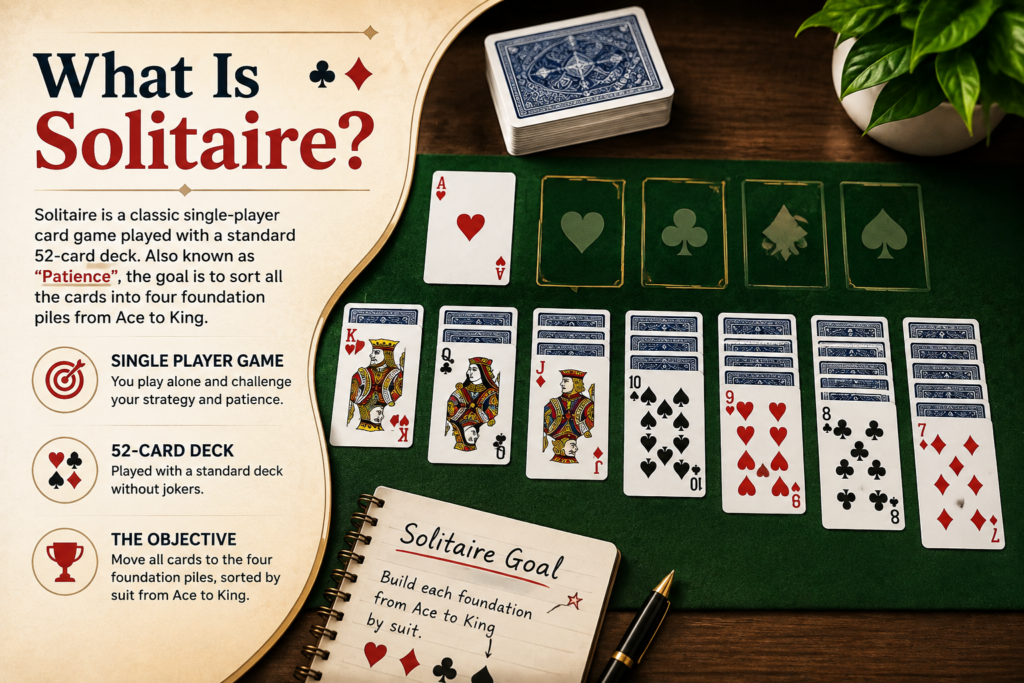
Solitaire is a single player card game played with a standard 52 card deck. It’s also widely known as “Patience” especially in the UK and Europe because the goal is to patiently sort every card into order. If you’re learning how to play solitaire this classic version is a great place to start.
The version most people mean when they say “solitaire” is Klondike Solitaire. It’s the classic layout that’s shipped on many Windows PCs since the early 1990s. That’s the version this guide focuses on.
The objective is simple in theory: move all 52 cards into four foundation piles sorted by suit from Ace to King. Getting there is where the strategy comes in.
What You Need to Play Solitaire?
You don’t need much to start:
- One standard 52-card deck (no jokers)
- A flat surface such as a table, desk or even the floor
- A few minutes of quiet focus
That’s it. No board and no special equipment. This is part of why solitaire has stayed popular for over a century. It’s portable and endlessly repeatable.
How to Set Up Solitaire?
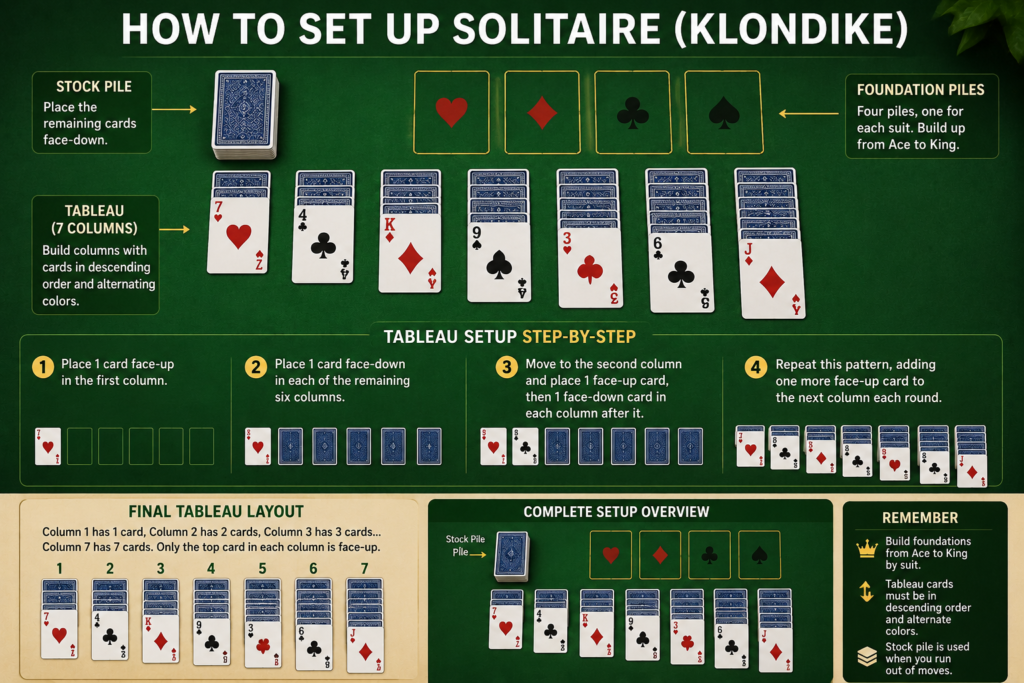
Setting up correctly is half the battle. Get the layout wrong and the rest of the game falls apart. Here’s the setup used in traditional Klondike solitaire.
How to Arrange the Tableau?
The tableau is the main playing area made up of seven columns of cards. Deal them out like this:
- Place 1 card face-up starting the first column.
- Place 1 card face-down in each of the remaining six columns.
- Move to the second column and place 1 card face-up then 1 face-down card in each column after it.
- Repeat this pattern adding one more face-up card to the next column each round.
By the end column 1 has 1 card. Column 2 has 2 cards. Column 3 has 3 cards and so on up to column 7 which has 7 cards. Only the top card in each column stays face-up while everything underneath stays face-down.
This setup is an important part of learning how to play solitaire because it determines how you can move and uncover cards during the game.That’s how many rows are in solitaire. There are seven columns with the card count increasing by one as you move from left to right.
What Are the Foundation Piles?
Above the tableau you’ll leave four empty spaces. These are the foundation piles. One for each suit. If you’re learning how to play solitaire you need to build these piles in order from Ace to King as the game progresses. Winning solitaire means filling all four.
The remaining cards after the tableau is dealt form the stock pile. You’ll place this face-down to the side as your draw pile for the rest of the game.
How to Play Solitaire Games With a Deck of Cards?
Once the tableau is set here’s how a round actually plays out.
Moving Cards Within the Tableau
You can move face-up cards between tableau columns but only if they follow a strict pattern:
- Cards must be placed in descending order (King, Queen, Jack, 10 and so on).
- Cards must alternate in color. A red 7 can only go on a black 8 for example.
- You can move a single card or a valid sequence of cards together as long as the sequence itself follows the descending alternating-color rule.
When you clear a face-up card off a column and reveal a face down one underneath, flip it over. That card is now in play.
Using the Stock Pile
When you run out of moves in the tableau, draw from the stock pile. Depending on the version you’re playing you’ll draw either one card or three cards at a time.
- If you draw one card you can either play it or move it to a waste pile.
- Cards from the waste pile can be played onto the tableau or foundation following the same rules as any other card.
- Once the stock pile runs out you can typically flip the waste pile over and use it again though some rule sets limit how many times you can do this.
Building the Foundation Piles
Any Ace can be moved to a foundation pile as soon as it’s available. Once you understand how to play solitaire you can build each foundation pile upward in order and by matching suit: Ace, 2, 3 and so on up to King. You win the game once all 52 cards are sorted into the four foundation piles.
Types of Solitaire and Popular Variations
Klondike isn’t the only version of solitaire out there. Once you’re comfortable with the basics of how to play solitaire it’s worth trying a few of these popular variations to discover which style you enjoy most.
Klondike Solitaire
This is the standard version described above with seven tableau columns, four foundation piles and a stock pile. When most people say solitaire they mean Klondike.
If you enjoy simple puzzle games and want to explore another popular challenge, you can also learn how many levels are in Candy Crush.
Pyramid Solitaire
Instead of columns, cards are arranged in a triangular pyramid. The goal is to remove pairs of cards that add up to 13 clearing the pyramid one match at a time. It’s a faster, more puzzle-like variation.
Spider Solitaire
Played with two decks instead of one, Spider Solitaire uses ten tableau columns. The goal is to build complete suit sequences from King to Ace within the tableau itself rather than moving cards to separate foundation piles.
FreeCell
FreeCell deals all 52 cards face-up from the start along with a few “free cells” used as temporary holding spots. Because you can see every card immediately, FreeCell relies more on planning than luck.
Double Solitaire
This is one of the few truly social versions. Two players each work with their own deck racing to build shared foundation piles faster than their opponent. It’s a good option if you’re looking for solitaire games with two decks of cards for a group setting.
How to Play Solitaire Alone?
Solitaire is by design meant to be played alone. That’s the whole point of the name. If you’re learning how to play solitaire with a physical deck rather than a screen a few habits can make solo play smoother:
- Deal slowly and double-check your tableau count before you start moving cards.
- Keep your waste pile slightly fanned so you can see which cards are underneath.
- Give yourself a few minutes before deciding a game is unwinnable. Many hands that look stuck open up after two or three more draws.
Winning Tips and Strategies
A few habits separate players who win consistently from players who get stuck early:
Uncover face down cards early
Prioritize moves that reveal new cards over moves that just rearrange what’s already visible.
Don’t rush Aces and 2s to the foundation
Sometimes it’s better to leave a low card in the tableau briefly if it helps you move a longer sequence.
Empty columns are valuable
A fully cleared column can hold a King opening up more of the tableau. Work toward creating one early.
Plan a few moves ahead
Before drawing from the stock pile check whether the current tableau has any moves left.
How to Score in Solitaire?
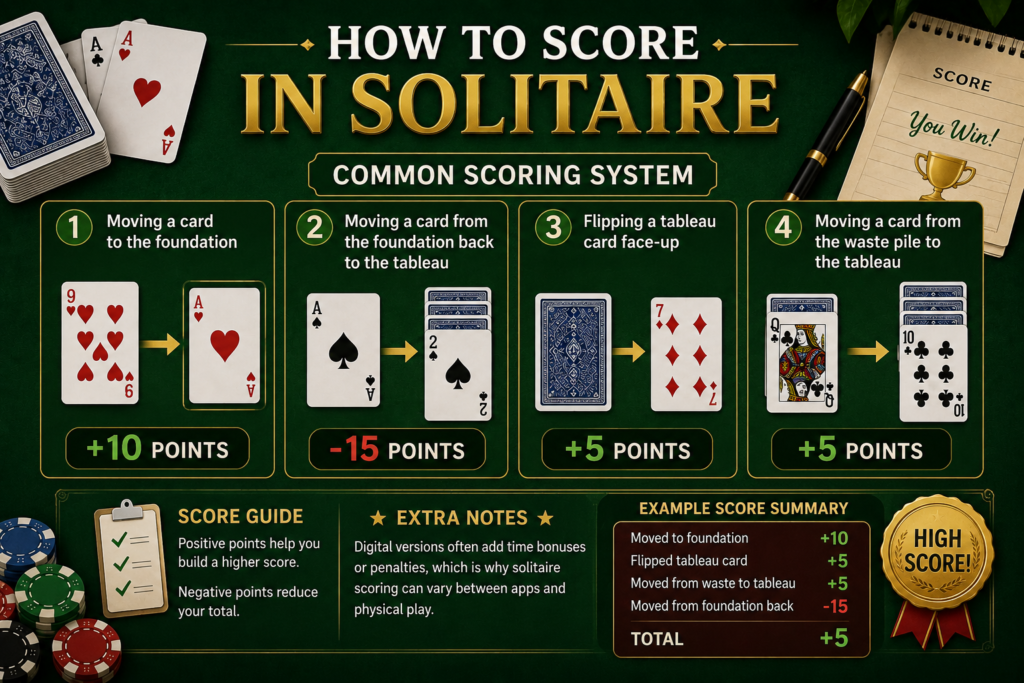
Traditional solitaire scoring depends on which rule set you’re using but a common standard version works like this:
- Moving a card to the foundation: +10 points
- Moving a card from the foundation back to the tableau: -15 points
- Flipping a tableau card face-up: +5 points
- Moving a card from the waste pile to the tableau: +5 points
Digital versions often add time bonuses or penalties which is why solitaire scoring can vary between apps and physical play.
Conclusion
Solitaire rewards patience more than luck. Once the tableau setup and card-movement rules click the rest is about spotting the right sequence at the right time. If you understand how to play solitaire and practice the basic strategies regularly you can improve your chances of winning.
Start with a few practice rounds of Klondike, get comfortable with the tableau and foundation piles, then branch out into Pyramid or Spider solitaire once you want a new challenge.Deal a hand, work through it slowly and you’ll notice your win rate climbing within just a few games.Explore more on Pepper0.
Frequently Asked Questions
How many rows are in solitaire?
Klondike solitaire uses seven columns (rows) in the tableau with card counts increasing from 1 to 7 as you move across.
Can you play solitaire with a deck of 51 cards?
No. Solitaire requires the full 52-card deck. A missing card will make the game impossible to win so it’s worth counting your deck before you start.
Is solitaire easy or hard for beginners?
The rules are easy to learn in a few minutes but winning consistently takes practice. Most beginners start winning regularly after ten to fifteen games.
How many cards across for solitaire?
Seven columns are dealt across the tableau using 28 cards total, with the remaining 24 cards forming the stock pile.
What is the foundation in solitaire?
The foundation refers to the four piles, one per suit, where you build cards in order from Ace to King. Filling all four foundation piles wins the game.