

Ice hockey is played in three periods each 20 minutes long, giving a regulation game a total playing time of 60 minutes.
This format applies across most levels of the sport including the NHL, Olympic hockey and college hockey, though overtime and shootout rules vary by league.
Hockey’s period structure isn’t arbitrary. It was designed around player fatigue, ice conditions and broadcast logistics.
This guide covers exactly how the format works across every major league, why the sport moved to three periods instead of two halves, and how intermissions and overtime rules differ from the NHL to the Olympics.
How Many Periods Are in Ice Hockey?
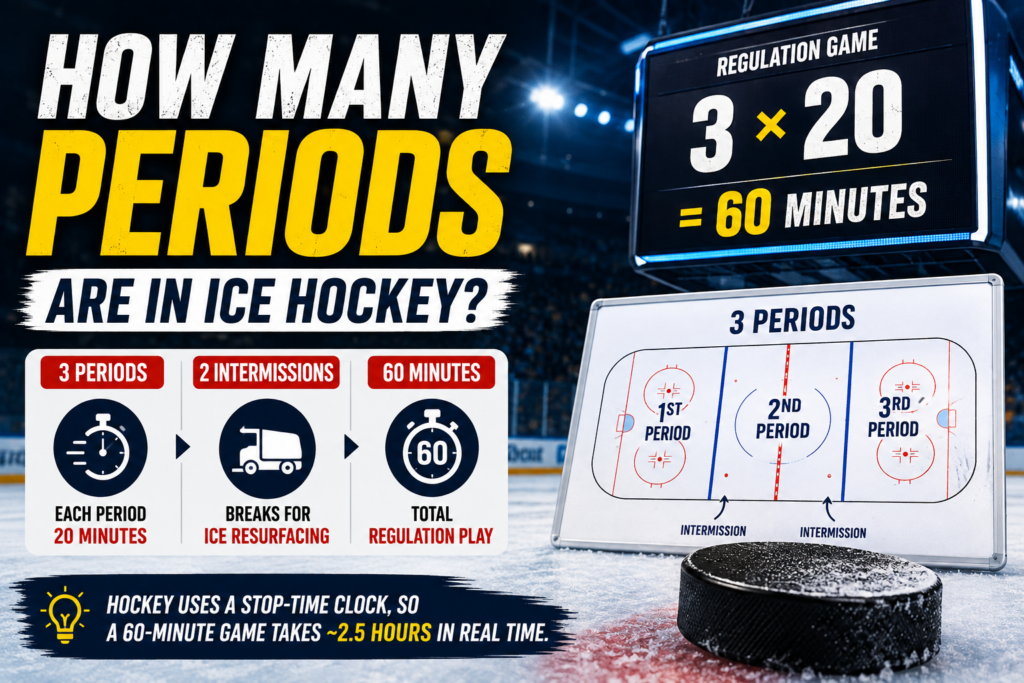
A standard ice hockey game consists of three periods of 20 minutes each, so how many periods in hockey is a simple answer: three, separated by two intermissions. This 60-minute regulation format is used by the NHL, IIHF (International Ice Hockey Federation), NCAA and most professional and international leagues around the world.
The clock in hockey is a stop-time clock, meaning it pauses for whistles, penalties, goals and other stoppages. Because of this, a single 20-minute period on paper usually takes closer to 30-35 minutes to complete in real time.
That’s why a full three-period game often runs about two and a half hours once you factor in intermissions, stoppages and TV timeouts.
Why Three Periods Instead of Two Halves?
Hockey wasn’t always played in three periods. Early versions of the game, including some 19th-century matches, used two 30-minute halves, a format borrowed from sports like soccer and rugby. This history helps explain how many periods in hockey became the standard format used today. The switch to three periods happened for a practical reason: ice quality.
Skating wears down ice surfaces quickly, creating ruts, snow buildup and rough patches that slow the puck and increase injury risk. By splitting the game into three shorter periods instead of two long halves, rinks could resurface the ice twice during a game instead of once, keeping conditions safer and more consistent. This change became standard by the early 1900s and has remained the format ever since.
How Long Is Each Period in Hockey?
Each period in a standard hockey game lasts 20 minutes of game time. Across three periods that totals 60 minutes of regulation play. This applies to the NHL, Olympic hockey and most adult leagues worldwide.
Youth and amateur leagues often shorten this. Depending on the age group and organization periods can run 10, 12 or 15 minutes instead of the full 20, and some youth games use a running clock that doesn’t stop for whistles which keeps games moving faster for younger players.
What Happens Between Periods? (Intermission)
Between each period teams get a break called an intermission which typically lasts 15 to 18 minutes in the NHL and slightly less in college or international play. Two things happen during this window that make it longer than a typical sports timeout.
Ice Resurfacing
A machine called a Zamboni drives across the rink to shave down rough ice, fill in ruts and lay a fresh layer of water that freezes into a smooth surface.
Skipping this step would make the ice progressively more dangerous and unpredictable as the game goes on, so resurfacing happens after every period not just at halftime.
Player Recovery
Players head to the locker room to rehydrate, review strategy with coaches and adjust equipment. Because hockey shifts are short and explosive (most players are only on the ice for 45 seconds to a minute at a time before switching out) the intermission is also when coaches finalize line combinations and adjust matchups based on how the period played out.
How Many Periods in Olympic Hockey?
Olympic ice hockey follows the same three-period 20-minute format used in the NHL and most international competitions, governed by IIHF rules rather than NHL rules.
Olympic Hockey Period Format
Both men’s and women’s Olympic hockey use 20-minute periods across three periods for a 60-minute regulation game. The main difference from NHL hockey shows up in rink size since Olympic rinks are wider than NHL rinks, which tends to produce a faster more perimeter-based style of play though the period structure itself stays the same.
Overtime and Shootout Rules at the Olympics
If you’re wondering how many periods in hockey are played at the Olympics, the regulation format remains three periods before overtime begins. If an Olympic game is tied after regulation in the knockout stage, teams play a five-minute 3-on-3 overtime period.
If the score is still tied after that, the game moves to a shootout. Preliminary round games handled ties differently in recent Olympic tournaments, sometimes allowing games to end in a draw before the knockout stage begins, so it’s worth checking the specific tournament format for that detail.
How Many Periods in NHL Hockey?
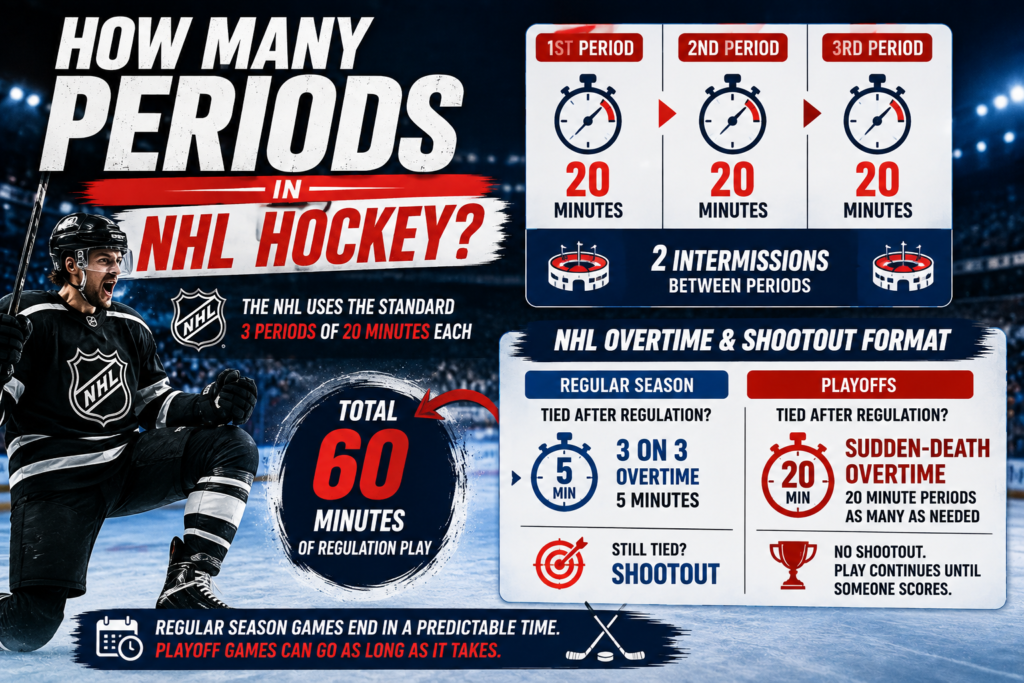
The NHL uses the standard three periods of 20 minutes each with two intermissions, matching the format used across most of the hockey world.
NHL Overtime and Shootout Format
The NHL resolves ties differently from Olympic and international rules. In the regular season, a tied game goes to a five-minute 3-on-3 overtime, followed by a shootout if no one scores.
In the playoffs, there’s no shootout. Teams play full 20-minute sudden-death overtime periods, as many as needed, until someone scores. Some playoff games have stretched past multiple overtimes.
So a regular-season game ends within a fairly predictable window, while a playoff game can run indefinitely until the tie is broken.
How Many Periods in College Hockey?
NCAA hockey also uses three 20-minute periods, consistent with the NHL and international format, which helps explain how many periods in hockey are played at the college level. For overtime, NCAA rules vary depending on whether the game is in the regular season or postseason.
Regular-season ties can sometimes end in a draw after one overtime period, while conference tournaments and the NCAA tournament use sudden-death overtime, playing full extra periods until a team scores since postseason games require a winner.
How Many Periods in Women’s Hockey?
Women’s hockey, whether at the Olympic, NCAA or professional level such as the PWHL, also follows the three-period 20-minute format.
The core period structure doesn’t differ by gender. What changes, similar to men’s hockey, is how each league handles overtime and shootouts based on whether the game is a regular-season match or an elimination game.
How Many Periods in Minor League and AHL Hockey?
The American Hockey League (AHL), the primary developmental league for NHL prospects, uses the same three 20-minute periods as the NHL, following the standard answer to how many periods in hockey. Its overtime format is similar too: a shortened 3-on-3 overtime followed by a shootout during the regular season, with full sudden-death periods used in the Calder Cup playoffs.
Other minor leagues, including the ECHL and various junior leagues like the OHL and WHL, also follow the standard three-period structure, though specific overtime rules can vary slightly by league.
Ice Hockey vs. Field Hockey: How Do Periods Compare?
Ice hockey and field hockey share a name and a general concept of scoring more goals than your opponent, but their timing structures are completely different.
| Format | Periods | Length | Total Regulation Time |
| Ice Hockey | 3 periods | 20 minutes each | 60 minutes |
| Field Hockey | 2 halves | 35 minutes each (some leagues use 4 quarters of 15-17.5 minutes) | 70 minutes |
Field hockey, played on grass or turf rather than ice, doesn’t need the mid-game surface maintenance that drives ice hockey’s three-period format. That’s the main structural reason the two sports diverged.
Field hockey kept the traditional two half format common in outdoor sports while ice hockey moved to three periods largely for practical ice-related reasons.
How the Period Structure Affects Strategy?
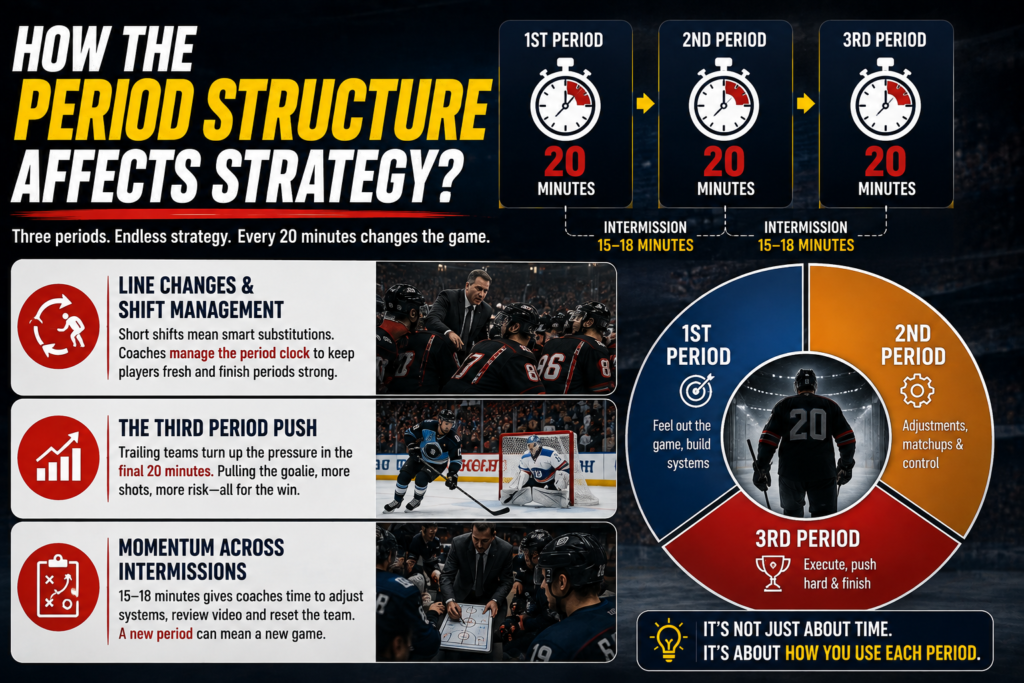
The three period format doesn’t just decide how long a game lasts. It shapes how teams actually play.
Line Changes and Shift Management
Because hockey shifts are short, coaches plan substitutions around the period clock, not just the game clock. A line that’s tired near the end of a period will often push for a quick shift change before the horn since the intermission gives a natural reset point.
Coaches also track which of their top players get the last shift of a period and the first shift of the next one, since a strong start to a fresh period can set the tone for the next 20 minutes.
The Third Period Push
Anyone who follows hockey closely has heard commentators reference the third period push, the tendency for the trailing team to increase pressure and pull their goalie late in the final period if they’re down by a goal or two. This strategy only makes sense because understanding how many periods in hockey gives teams a clearly defined final stretch to work with.
A team trailing after the first period still has 40 minutes left to respond, but a team trailing with two minutes left in the third period is in a genuine must-score situation, which changes how aggressively they play.
Momentum Across Intermissions
Intermissions can also shift momentum in ways a mid-half timeout in other sports doesn’t. A full 15-to-18-minute break gives coaches real time to adjust systems, review video or rest an injured player, which means a team that was dominated in the first period can come out in the second period playing a noticeably different style.
This is part of why hockey analysts often break down games period by period rather than treating the 60 minutes as one continuous stretch.
Conclusion
At its core the answer to how many periods in hockey is simple: three periods of 20 minutes each, adding up to 60 minutes of regulation play. What makes the format interesting is the reasoning behind it.
Ice maintenance shaped the sport’s entire structure over a century ago and that same three-period system still governs everything from Olympic finals to your local college rink today.
The details that change from league to league, like overtime formats and intermission length, are worth knowing too, especially if you’re watching a close game headed into extra time.For more guides and articles across different topics, explore Pepper0.
Frequently Asked Questions
How many periods are there in hockey?
Ice hockey has three periods each lasting 20 minutes for 60 minutes of total regulation play.
How many minutes are in a hockey period?
Each period is 20 minutes long at most professional, Olympic and college levels, though youth leagues often use shorter periods of 10 to 15 minutes.
Why does hockey have three periods instead of two halves?
The three-period format was adopted in the early 1900s so rinks could resurface the ice twice during a game instead of once, keeping the playing surface safer and more consistent.
Do all hockey leagues follow the same period rules?
Regulation period length (three periods of 20 minutes) is consistent across the NHL, Olympics, NCAA, AHL and most professional leagues. What differs between leagues is how overtime and shootouts are handled, particularly between regular-season and playoff or elimination games.