
Project teams can have skilled managers, experienced employees, and good project management software and still struggle when nobody is sure who has the authority to make important decisions.
A project may be progressing well until a major scope change appears. The project manager may know what should happen next, but the decision could require executive approval. Meanwhile, the sponsor expects the project team to move forward and another department is waiting for an answer.
That is where governance becomes important.
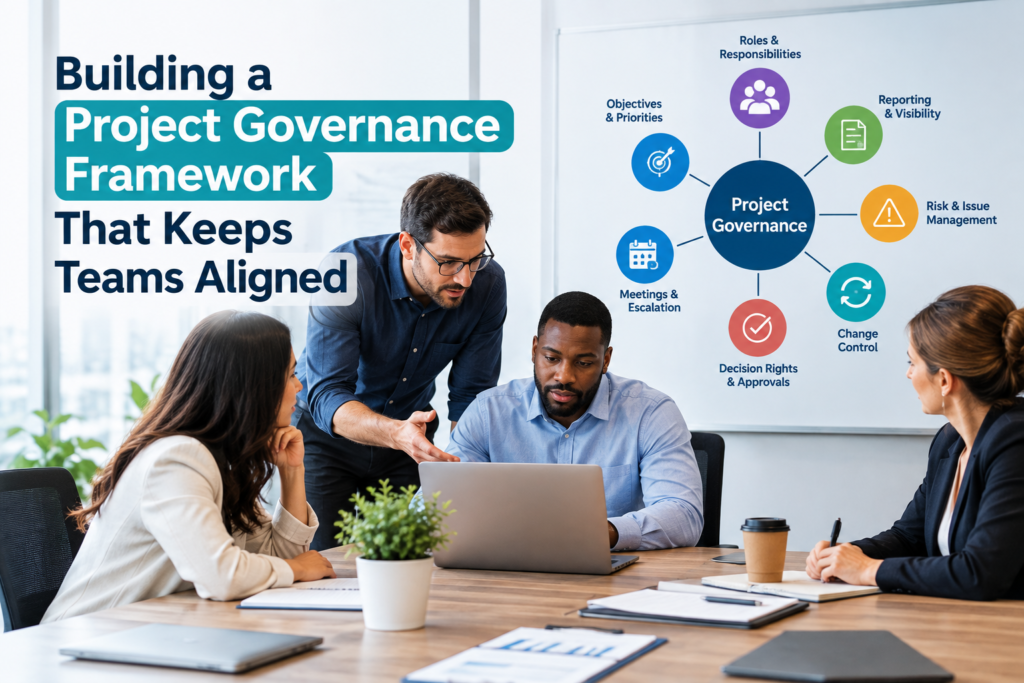
A well-designed project governance framework creates a clear connection between business priorities and day-to-day project decisions. It defines who has authority, what information needs to be reported, when issues should be escalated, and how important changes should be reviewed.
The goal is not to create another layer of meetings. The goal is to make project decisions clearer and more consistent.
What Project Governance Actually Controls
Project management focuses heavily on getting the work done.
Governance focuses on the environment in which those decisions are made.
A project governance model can establish rules for:
- Who sponsors the project
- Who manages day-to-day delivery
- Who approves major changes
- Who owns business decisions
- How risks are escalated
- How project health is reported
- How budget changes are handled
- How priorities are reviewed
- When leadership should intervene
- How the project is closed
This distinction matters because project managers should not have to solve every organizational decision themselves.
For example, a project manager can identify that a major requirement change will affect the delivery date. Governance should make it clear whether the manager can approve the change, whether the sponsor needs to decide, or whether the issue needs to go to a higher decision-making group.
Without that clarity, projects can become stuck between authority levels.
Start With the Decisions That Cause the Most Friction
One of the easiest mistakes is to begin governance design by creating documents.
Start with decisions instead.
Think about the decisions that repeatedly slow projects down.
They might include:
- Scope changes
- Budget increases
- Schedule changes
- Resource conflicts
- Major technical risks
- Vendor decisions
- Customer commitments
- Priority changes
- Project cancellation
- Escalated issues
For each decision, ask three questions.
Who needs to provide information?
Who has the authority to decide?
Who needs to know about the decision afterward?
The answers create the foundation of your governance model.
This approach is more practical than creating a large policy document and expecting teams to figure out how it applies later.
Define Clear Roles Before Creating Committees
A governance structure does not need a large committee for every project.
The key is to establish clear accountability.
A typical project environment may involve several roles.
Project Sponsor
The sponsor provides senior-level support and helps connect the project to business objectives.
The sponsor may also make decisions that exceed the authority of the project manager.
Project Manager
The project manager is responsible for coordinating project execution within the agreed boundaries.
That normally includes planning, team coordination, tracking, communication, risk management, and issue management.
Project Team
The team performs the work required to deliver the agreed outcomes.
Team members should understand their responsibilities and know when an issue needs to be escalated.
Steering Group or Leadership Team
Some complex projects need a group that can make cross-functional decisions.
This can be particularly useful when a project affects several departments or requires significant investment.
PMO
Where an organization has a PMO, it may support governance through standards, reporting, portfolio visibility, processes, templates, and coordination.
The PMO should not automatically become the owner of every project decision.
Its role should match the organization’s needs and authority structure.
Create a Decision Rights Model
A useful governance model should answer one simple question:
Who gets to decide?
A decision rights table can make this visible.
| Decision Area | Project Manager | Sponsor | Leadership or Steering Group |
|---|---|---|---|
| Day-to-day delivery | Owns | Informed | Informed |
| Minor schedule adjustment | Usually approves | Informed | Not normally involved |
| Major scope change | Recommends | Approves when within authority | Approves when strategically significant |
| Major budget change | Recommends | Reviews | Approves when above threshold |
| Critical project risk | Manages and escalates | Reviews | Decides when broader action is needed |
| Cross-project resource conflict | Raises issue | Helps resolve | Decides when priorities conflict |
| Project cancellation | Recommends | Reviews | Decides when business impact is significant |
The exact authority levels should be customized.
A $10,000 decision may be minor for one organization and significant for another. The framework should reflect actual financial exposure, risk, project size, and organizational authority.
Separate Oversight From Daily Project Management
Governance becomes frustrating when leaders try to manage every task.
A sponsor does not need to decide which employee completes a task on Tuesday.
A steering group does not need to review every project email.
Likewise, project managers should not be expected to make strategic decisions that belong to senior leadership.
A healthy division looks something like this:
Governance asks:
- Is the project still aligned with the business objective?
- Are the risks acceptable?
- Is additional investment justified?
- Does a major change require approval?
- Should priorities change?
- Should the project continue?
Project management asks:
- What needs to be done?
- Who will do it?
- When will it be completed?
- What dependencies exist?
- What actions are needed today?
Keeping these responsibilities separate reduces micromanagement while preserving appropriate oversight.
Build Reporting Around Decisions
Project reporting often becomes excessive because organizations try to measure everything.
More information does not automatically mean better governance.
A useful report should help someone understand the current situation and determine whether action is required.
For example, a leadership report may focus on:
- Overall project health
- Major milestones
- Budget position
- Key risks
- Critical issues
- Scope changes
- Resource concerns
- Decisions required
- Upcoming milestones
The exact format can vary.
The important point is that reporting should be connected to decisions.
If a report contains twenty pages of information but does not tell leadership what needs attention, it is not doing its governance job particularly well.
Establish a Practical Escalation Path
Every project will eventually encounter an issue that cannot be solved at the current level.
The problem is not that escalation happens.
The problem is when nobody knows how or when to escalate.
A practical escalation path should explain:
- What qualifies as an escalation
- Who receives the escalation
- What information should accompany it
- How quickly a decision is expected
- Who has authority to resolve it
- How the final decision is recorded
For example, a project manager may handle a small delivery issue directly.
A major supplier failure could require sponsor involvement.
A problem that affects several projects could require portfolio-level attention.
This prevents every problem from reaching executives while ensuring serious issues do not remain hidden.
Make Risk Management Part of Governance
Risk management should not be treated as a separate activity that only appears in a project report.
Governance determines how much risk an organization is willing to accept and who has authority to respond when exposure increases.
A project governance framework should therefore establish:
- How significant risks are identified
- Who owns each risk
- How risks are rated
- When risks must be escalated
- Who approves major responses
- How risk trends are reported
- When a project needs a formal review
A project can remain on schedule while its risk profile becomes unacceptable.
That is why governance should look beyond simple progress percentages.
Design Change Control Without Creating a Bottleneck
Change is normal.
The objective of governance is not to prevent change. It is to prevent important changes from happening without understanding their consequences.
Before approving a significant change, decision makers may need to understand its effect on:
- Scope
- Schedule
- Budget
- Resources
- Quality
- Risk
- Customer commitments
- Business benefits
Small changes can usually remain within the project manager’s authority.
Larger changes may require sponsor or leadership approval.
The thresholds should be defined before a major change arrives. Otherwise, every change becomes a debate about who has authority.
Keep Governance Proportional to Project Risk
Not every project needs the same level of oversight.
A short internal project with a small budget should not require the same governance structure as a large transformation program.
A useful framework can classify projects by factors such as:
- Financial value
- Business impact
- Number of departments involved
- Regulatory exposure
- Technical complexity
- Customer impact
- Strategic importance
- Risk level
A low-risk project might use a simple sponsor, project manager, status report, and escalation process.
A high-risk project may need formal approval gates, a steering group, more frequent reporting, independent review, and stronger risk controls.
This proportional approach keeps governance useful instead of bureaucratic.
What Should a Project Governance Framework Include?
A practical framework does not need to contain every possible project management procedure.
It should contain the elements necessary to make oversight and decision-making clear.
| Governance Element | Main Purpose |
|---|---|
| Objectives and scope | Defines what the governance model covers |
| Roles and authority | Establishes accountability and decision rights |
| Reporting | Gives leaders reliable project information |
| Risk management | Defines how significant risks are handled |
| Issue escalation | Creates a path for problems requiring higher authority |
| Change control | Prevents major changes from bypassing review |
| Decision records | Creates visibility into important decisions |
| Meeting structure | Defines when governance discussions occur |
| Approval points | Identifies when formal authorization is required |
| Project closure | Confirms whether the project achieved its intended outcome |
The framework should be detailed enough to remove ambiguity but simple enough that project teams can actually use it.
How to Build the Framework Without Creating Unnecessary Bureaucracy
A practical implementation can happen in stages.
Step 1: Map the Current Problems
Talk with project managers, sponsors, department leaders, and other stakeholders.
Find out where projects currently get stuck.
Do not begin by asking what documents people want.
Ask where decisions are unclear, information is missing, priorities conflict, or accountability breaks down.
Step 2: Define Governance Boundaries
Decide which decisions belong to project teams and which require higher approval.
This is where the decision rights model becomes useful.
Step 3: Establish Core Roles
Define the sponsor, project manager, team responsibilities, PMO involvement, and any steering group responsibilities.
Avoid assigning responsibility without giving the person enough authority to perform it.
Step 4: Create a Small Reporting Standard
Choose the information leaders actually need.
Start small.
A concise status report with clear risks and decisions required can be more useful than a large report that nobody reads.
Step 5: Define Escalation Rules
Set thresholds for budget, schedule, risk, scope, and other major issues.
Make sure project managers know exactly when an issue needs to move upward.
Step 6: Test the Model on Real Projects
Do not assume the first version will be perfect.
Apply it to one or two projects and observe where people become confused or where the process creates unnecessary work.
Then adjust it.
For organizations that need to connect governance with a broader way of managing project work, this resource on project management methodology can provide additional context.
How to Know if Your Governance Model Is Working
A governance framework should produce practical improvements.
Look for signs such as:
- Decisions are reaching the right people faster
- Project managers understand their authority
- Executives receive more consistent information
- Major risks are escalated earlier
- Resource conflicts are identified sooner
- Scope changes are evaluated consistently
- Meetings focus more on decisions than status collection
- Teams spend less time creating duplicate reports
The goal is not to prove that governance exists.
The goal is to make project delivery easier to direct and control.
If people cannot explain who makes an important decision, the framework needs work.
If every decision requires a committee meeting, the framework may be too heavy.
If nobody escalates problems because the process is unclear, the framework is not doing its job.
When Should Governance Be More Flexible?
Flexibility becomes especially important when organizations manage different types of projects.
A software development initiative may need a different rhythm from a construction project.
A marketing campaign may require less formal approval than a major infrastructure investment.
A regulatory project may require more documentation than an internal process improvement initiative.
The governance model should therefore provide common principles while allowing project-specific adjustments.
Consistency should exist where consistency creates value.
Flexibility should exist where project conditions genuinely differ.
The Best Governance Model Is the One People Can Actually Use
A strong governance framework is not measured by the number of policies it contains.
It is measured by whether people know what they are responsible for, whether important decisions reach the right authority, and whether leadership has enough reliable information to act.
Start with the decisions that currently cause the most friction.
Clarify authority.
Create useful reporting.
Set practical escalation rules.
Adjust the level of governance to the risk and complexity of the project.
Then review the framework as the organization changes.
Governance should provide enough structure to keep projects aligned without turning normal project management into an administrative exercise.
FAQs
What is a project governance framework?
A project governance framework is a structured approach that defines how important project decisions are made, who has authority, how accountability works, how risks and changes are escalated, and how project performance is reviewed.
What are the main elements of a project governance framework?
Common elements include decision rights, roles and responsibilities, reporting, risk management, issue escalation, change control, approval points, governance meetings, and project closure.
Who should be responsible for project governance?
Responsibility depends on the organization and project. Senior sponsors typically provide strategic direction, project managers handle delivery, and PMOs may provide governance support, standards, reporting, and coordination.
How often should project governance meetings happen?
There is no universal schedule. Meeting frequency should reflect project risk, complexity, and the speed at which decisions are required. High-risk projects may need more frequent governance reviews than straightforward projects.
Can project governance slow down a project?
Yes, if it is designed poorly. Excessive approvals, unnecessary meetings, and duplicate reporting can create delays. Good governance should clarify decisions and reduce confusion rather than add bureaucracy.
Should every project use the same governance process?
Not necessarily. Organizations can establish common principles while scaling the level of oversight according to project size, complexity, risk, financial exposure, and business impact.
