
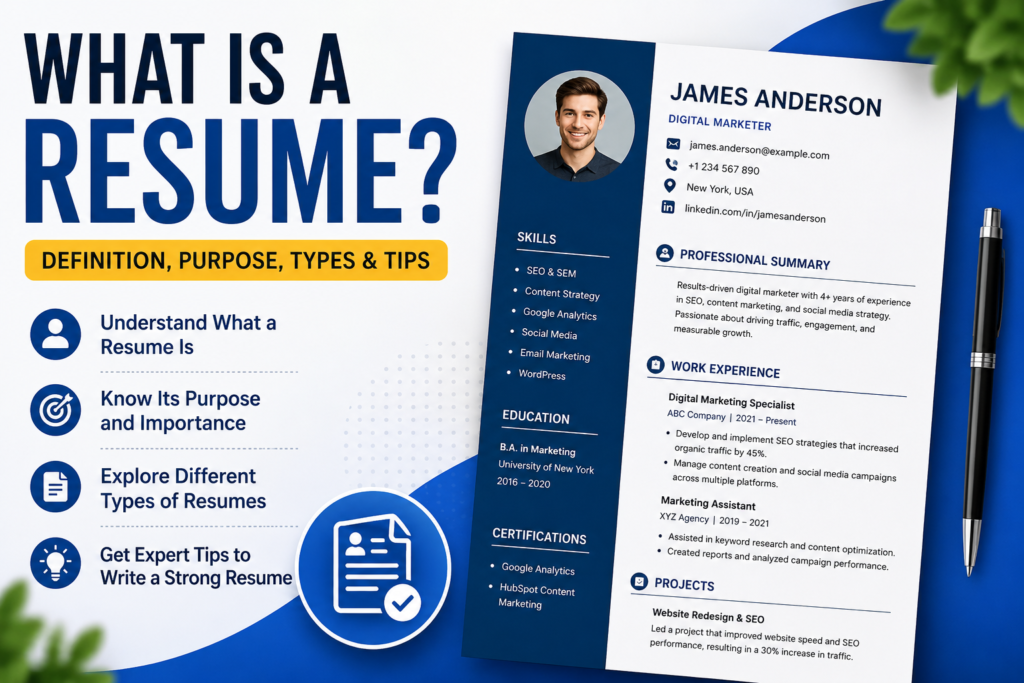
If you are applying for a job, you will likely need a resume. But what is a resume, and what does it actually do? A resume is a short professional document that presents your experience, education, skills and qualifications to a potential employer.
A resume gives employers a quick overview of your background and helps them decide whether your qualifications match the position. It is commonly used by students, recent graduates, experienced professionals, and people changing careers.
What Is a Resume?
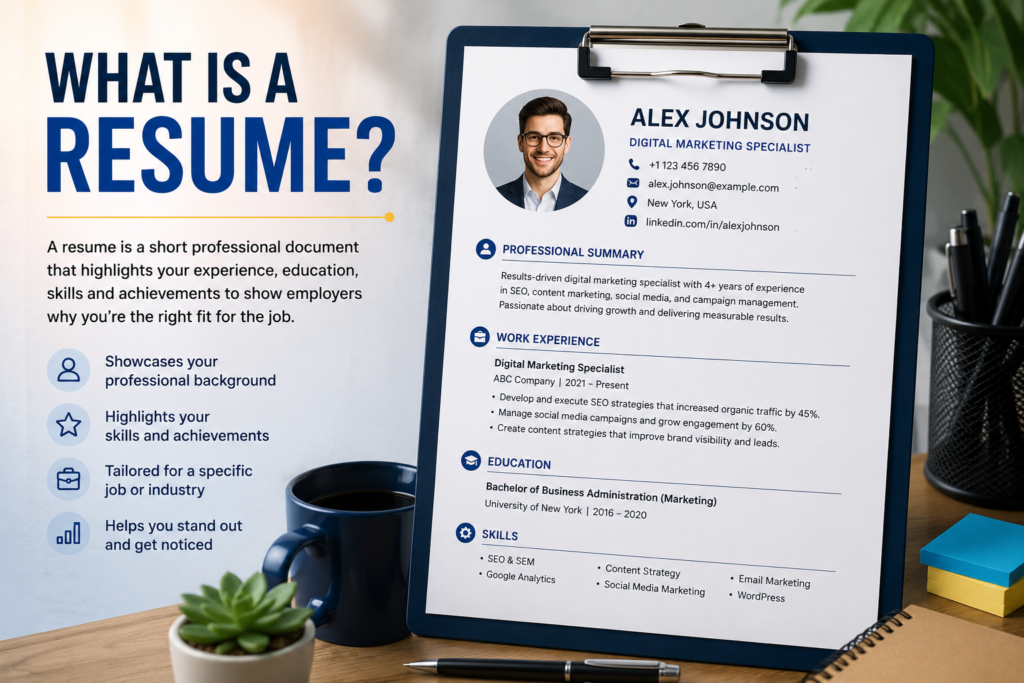
A resume is a professional document created for a job application. It summarizes the experience, education, skills, achievements, and other qualifications that are relevant to a particular position.
In simple terms, a resume tells an employer who you are professionally, what you can do, and why you may be suitable for the job. It is not meant to include every detail of your personal or professional life.
A good resume focuses on the information that matters to the employer. For example, someone applying for a content writing position might highlight writing experience, SEO knowledge, research skills, and published work.
Someone applying for an IT position may focus on technical skills, software, certifications, and relevant projects.The exact resume format can also vary depending on your career level and the type of job you want.
What Is the Purpose of a Resume?
The main purpose of a resume is to introduce your professional background to an employer and show why you could be a good fit for a position.
A resume is used to:
- Introduce your professional background.
- Show relevant qualifications and skills.
- Connect your experience with the job requirements.
- Highlight important achievements.
- Help employers decide who should move to the interview stage.
Think of your resume as a focused presentation of your professional value. Instead of simply saying that you are qualified, you use your experience, skills, and achievements to demonstrate it.
For example, a candidate applying for an SEO position could mention keyword research, technical SEO, content optimization, and measurable traffic improvements. This gives the employer a clearer reason to consider the candidate.
What Should a Resume Include?
The main parts of a resume give employers the information they need to understand your background. You do not necessarily need every possible section. Choose the ones that are relevant to your experience and the position.
Contact Information
Include your full name, professional email address, phone number, and location. Make sure the information is accurate and easy to find.
Professional Summary or Objective
A professional summary briefly presents your experience, strengths, and relevant qualifications. A resume objective focuses more on your career goal and the type of position you want.
Work Experience
List relevant positions with your employer, job title, dates, responsibilities, and achievements. Focus on what you accomplished rather than simply listing daily tasks.
Education
Add your relevant degrees, diplomas, schools, universities, and graduation information. Students and recent graduates can give this section more attention when they have limited work experience.
Skills
Include skills that are relevant to the position. These may include technical skills, software knowledge, communication abilities, research skills, or industry-specific expertise.
Certifications and Projects
Relevant certifications, courses, internships, freelance projects, and personal projects can strengthen a resume. Include them when they demonstrate skills related to the job.
What Is a Resume Summary?
A resume summary is a short professional introduction that appears near the top of a resume. It gives the employer a quick overview of your experience, skills, and strongest qualifications.
A good summary should be specific and relevant to the job. Instead of using general phrases such as “hardworking professional,” mention your field, experience, and key strengths.
For example, a digital marketing professional could mention experience with SEO, content strategy, keyword research, and website optimization. This immediately tells the employer what the candidate does and what skills they bring.
A resume summary is especially useful for people who already have relevant experience. It should be concise and give the employer a reason to continue reading.
What Is a Resume Objective?
A resume objective is a short statement that explains your career goal and the type of position you are seeking. It can be useful for students, recent graduates, career changers, and people applying for their first job.
For example, someone applying for their first marketing position could mention their marketing education, relevant projects, and interest in developing their skills in a professional environment.
A good objective should also show what you can contribute. Avoid writing only about what you want from the company.
If you already have substantial relevant experience, a professional summary will often provide more useful information because it focuses on what you can offer the employer.
What Are the Different Types of Resumes?
Different types of resumes organize your information in different ways. The right choice depends on your work history, skills, and career goals.
Reverse-Chronological Resume
A reverse-chronological resume focuses on your work experience and lists your most recent position first. It is a common choice for professionals with a steady career history.
This format makes it easy for employers to see where you have worked and how your career has progressed.
Functional or Skills Based Resume
A functional or skills-based resume focuses more on your abilities than your employment history. It can be useful for career changers, people returning to work, or candidates whose skills are more relevant than their job history.
Instead of making employment dates the main focus, this format groups information around skills and areas of expertise.
Combination Resume
A combination resume brings together skills and work experience. It allows you to highlight important abilities while still showing your employment history.
This format can work well for experienced candidates who want to emphasize specific skills while maintaining a clear career timeline.
How to Format a Resume?
A professional resume should be clean, readable, and easy to scan. Employers may review many applications, so important information should be easy to find.
Use a simple font such as Arial, Calibri, Helvetica, or Georgia. The best font for a resume is one that remains clear and professional on both screens and printed pages.
Use consistent headings, spacing, font sizes, and bullet points. Avoid excessive colors, large graphics, and complicated designs unless you are applying for a creative position where visual presentation is important.
Keep the document focused on relevant information. A one page resume can work well for students and early-career candidates, while experienced professionals may need two pages.
For technical roles, your resume can also mention relevant technical knowledge and tools. For example, someone applying for an IT or networking position may highlight knowledge of IP addresses when it relates directly to the job requirements.
Resume vs. CV: What’s the Difference?
A resume and a CV are not always the same thing. Their meaning can depend on the country and type of job.
In the United States, a resume is generally a concise document tailored to a specific job. A CV is usually more detailed and may include academic achievements, research, publications, teaching experience, conferences, and other professional activities.
In countries such as the United Kingdom, the term CV is commonly used for a document that is similar to what American employers call a resume.
The best approach is to check the job advertisement and local expectations before deciding whether to submit a resume or CV.
How to Write a Resume?
Start by reading the job description carefully. Identify the skills, qualifications, and experience the employer wants and then highlight the parts of your background that match those requirements.
Use specific examples instead of vague statements. For example, “Managed SEO campaigns and increased organic traffic by 30%” tells an employer much more than “Responsible for SEO.”
If you are creating a resume for your first job, you may not have much professional experience. That does not mean you have nothing to include. Education, internships, freelance work, personal projects, volunteer experience, certifications, and relevant skills can all demonstrate your abilities.
A resume with no experience should focus on transferable skills and evidence of what you can do. Projects can be particularly useful because they show that you have applied your knowledge in a practical way.
You should also tailor your resume to each important application. A professional resume should not look like a generic document sent to every employer. Adjust relevant skills, achievements, and descriptions to match the position.
Before submitting it, check your spelling, grammar, dates, contact information, and formatting. Most importantly, keep everything accurate and never add qualifications or experience you do not have.
Common Resume Mistakes to Avoid
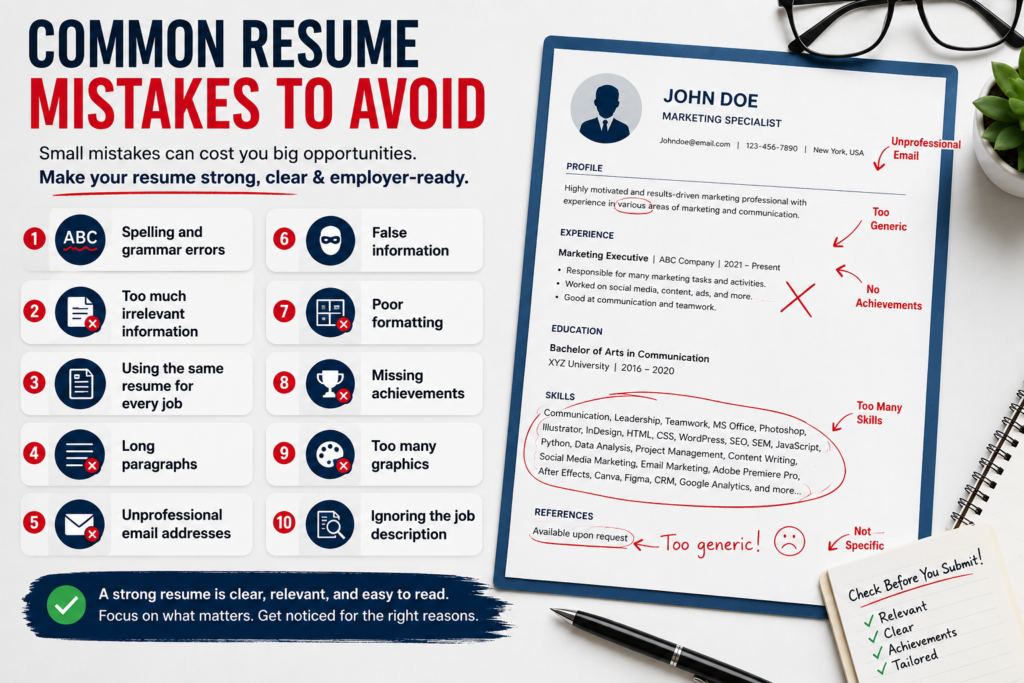
Even a qualified candidate can weaken an application with a poorly prepared resume. Avoid these common mistakes:
Spelling and grammar errors
Too much irrelevant information
Using the same resume for every job
Long paragraphs
Unprofessional email addresses
False information
Poor formatting
Missing achievements
Too many graphics
Ignoring the job description
A strong resume is not necessarily the most colorful or complicated one. It is the one that makes your relevant qualifications easy to understand.
Conclusion
A resume gives employers a clear overview of your skills, experience, education, and qualifications. Its purpose is to show how your background matches the job you are applying for.
Whether you are writing a resume for your first job or an experienced position, keep it clear, relevant, and easy to read. Focus on the skills and experience that matter most for the role.
Use a professional format and tailor your resume to each job. A well written resume makes your qualifications easier to understand and can help you make a stronger impression on employers.
Frequently Asked Questions About Resumes
What is a resume used for?
A resume is used to present your professional background to an employer. It highlights your experience, education, skills, and qualifications and helps the employer decide whether to consider you for an interview.
How long should a resume be?
A one-page resume is often suitable for students and early-career candidates. Professionals with extensive relevant experience may use two pages when necessary.
What should a resume include?
A resume commonly includes contact information, a professional summary or objective, work experience, education, skills, and relevant certifications or projects.
Can I make a resume without work experience?
Yes. You can include education, projects, internships, volunteer work, certifications, freelance work, and transferable skills to demonstrate your abilities.
What is the best resume format?
The best format depends on your experience and career situation. Reverse-chronological resumes work well for candidates with a consistent work history, while functional or combination formats may suit people with different career backgrounds.
Is a resume the same as a CV?
Not always. In the United States, a resume is generally shorter and tailored to a specific job, while a CV is usually more detailed and commonly used for academic or research positions. In other countries, the terms may be used interchangeably.